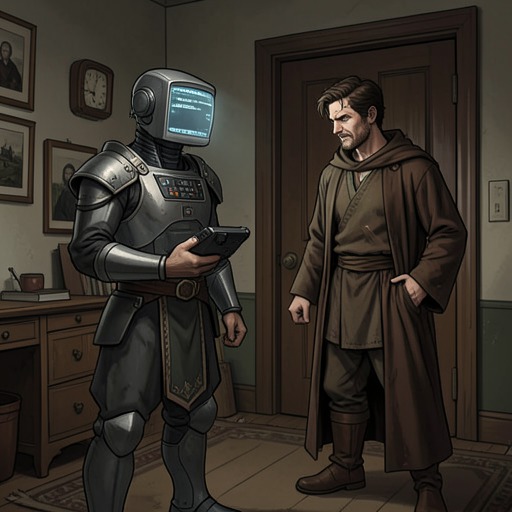
Lorian monitors
The Robot Who Looked Like MeThe Lorian monitors are the civic guides and law-related officials of Loris, a society that describes their work as educational rather than punitive. Their ordinary authority rests on explanation, apology, and voluntary cooperation, not arrest. Johnny Bezique’s arrival tests that arrangement: as his aggression escalates, monitors who are accustomed to peaceful encounters must move from courteous guidance to armed enforcement, while still treating him as an alien whose conduct and low level of civilization should mitigate his case.
Role and ordinary practice
The monitors operate in a society that appears, to Johnny, almost impossibly harmonious. Their existence initially strikes him as evidence that Loris must have criminals, since he associates police with lawbreakers. Helmis corrects that assumption: Loris has occasional genetic deviants, but no criminal class, and the monitors belong to education rather than law enforcement. Citizens can ask a monitor for a ruling on personal conduct; if someone breaks a law inadvertently, the monitor points it out, the citizen apologizes, and the incident is forgotten.
The system’s confidence extends even to repeated misconduct. When Johnny asks what happens if someone breaks the law again and again, Helmis says that such a circumstance never arises. Pressed on what would happen if it did, he explains that the monitors are programmed to handle such problems. The answer acknowledges a contingency without describing its procedure, leaving a quiet uncertainty beneath the assurance that Lorian order works. To Johnny, the monitors look too gentle to be effective; the narrative presents that impression alongside a society whose traffic, automatic systems, and daily life run smoothly.
Johnny Bezique tests the system
The conflict becomes practical when a counselor insists that Johnny accept social-adjustment therapy, judging his angry and aggressive moods a risk to other citizens. Johnny orders him to leave; when the counselor refuses to depart while the matter remains unresolved, Johnny punches him. The incident turns a discussion of conduct into an assault. The shocked counselor explains that violence actually committed is graver than violence merely offered and says Johnny will have to accept restraint until the case is cleared.
A monitor is sent to bring him in. Expecting the voluntary cooperation usual on Loris, the monitor is baffled when Johnny refuses and goes away for new orders. An hour later, the monitor returns with authority to use force if necessary. Johnny punches him too, framing the blow as a way of sparing the monitor from having to carry out that threat. This is not a misunderstanding that the system can settle through a routine apology: Johnny has assaulted both the counselor and the official charged with responding to him. He leaves for his ship, but its main drive has been removed by workmen who are cleaning and modernizing it as a gift from the Lorian people, preventing the immediate departure he hoped for.
From guidance to coercion
Johnny next tries to reach the Office of Future Projections, reasoning that a society without a ruler might still have important officials. A friendly native gives him the address. Four blocks from the office, a group of twenty monitors stops him and demands that he surrender. Their uncertainty is visible to Johnny, who suspects that arresting someone may be new to them. When he questions whether he is truly dangerous, a monitor apologizes, and Johnny is allowed to continue.
That accommodation does not end the pursuit. Within a block of his destination, another group stops him; Helmis is with them. Johnny claims that his orders have been countermanded and that he is now authorized to reveal his true identity. He proceeds confidently to the Planning Office door and orders it open. The earlier encounters have left space for persuasion, apology, and evasion, but this group responds differently: ten monitors in black, carrying weapons, confront him with a direct order to put up his hands and step away from the door. They say they are empowered to shoot to kill if necessary and have been instructed to ignore anything he says and take him in.
The contrast marks a change in the institution’s response, not an abandonment of its stated principles. The monitors tell Johnny that an ancient prison has been put back into service for him, where he will receive every amenity and be heard by a judge. They expect his alienness and low level of civilization to be considered, and predict that he will receive a warning and a request to leave Loris. Even after armed resistance and an explicit threat of lethal force, their stated destination is a hearing and a comparatively lenient disposition, not indefinite punishment.
Institutional limits and significance
The monitors’ conduct reveals both the strength and the boundary of Lorian order. In ordinary circumstances, they function through civility and shared expectations: a citizen asks for guidance, corrects an inadvertent breach, and returns to daily life. Their behavior toward Johnny initially follows that pattern, even when he refuses to comply. Yet his repeated assaults compel a graduated response: further orders, conditional authority to use force, larger groups, weapons, and finally the reopening of a prison.
Johnny’s presence makes visible a system whose smooth operation depends on the behavior it expects from its citizens. He interprets politeness as weakness and repeatedly acts on that judgment; the monitors’ restraint allows him to advance toward the Office of Future Projections, but it does not mean that they lack coercive power. When they finally deploy it, they retain a procedural and humane account of what should follow. The resulting tension is central to their portrayal: they are neither conventional police nor powerless bystanders, but educational guides whose exceptional enforcement role emerges only when an outsider makes the society’s normally untested safeguards necessary.